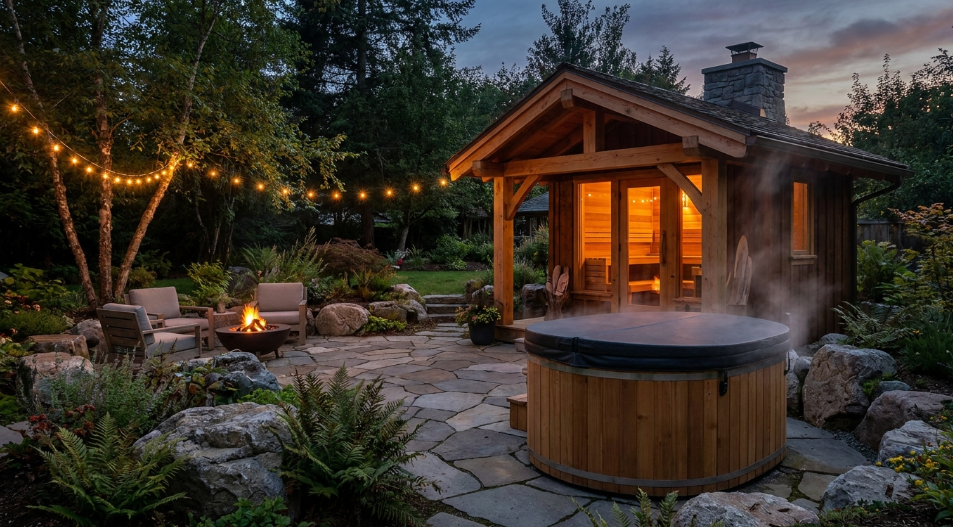
Western red cedar resists rot and warping through repeated wet-dry cycles on its own, thanks to natural oils in the wood, while heat-treated hemlock relies on a kiln process that alters the wood’s cell structure to reach similar stability without those natural oils. Cedar typically runs 20 to 40 percent more than heat-treated hemlock for a comparably sized barrel or tub shell. The right pick usually comes down to climate, budget, and how much natural silvering and weathering an owner is willing to let the wood do outdoors over the years.
What Actually Makes a Wood Species Work for a Cold Plunge?
A cold plunge shell spends its life in a wet-then-dry cycle that would rot most construction lumber within a few years: filled with water, drained for cleaning, exposed to humidity and condensation even when full. The wood needs to resist warping as it swells and contracts, resist fungal growth in a constantly damp environment, and hold a tight seal at the joints without excessive movement. Only a handful of species meet that bar without heavy chemical treatment, which is why the market for cold plunge shells narrows quickly to cedar, certain heat-treated softwoods, and increasingly molded composite or stainless shells that sidestep the wood question entirely.
How Does Western Red Cedar Hold Up in a Wet, Cold Setting?
Western red cedar contains natural thujaplicins and other extractives that resist fungal decay and insect damage without any added chemical treatment, which is the same property that makes it a common choice for outdoor decking and shingles. In a cold plunge specifically, cedar tends to develop a silver-gray patina outdoors within a year or two if left unsealed, purely cosmetic and not a sign of structural decline. It also has a lower density than many alternatives, which helps a bit with insulation but means panels need to be built slightly thicker for the same rigidity. Cedar’s main drawback is cost and, in some regions, availability of the clear, tight-grained stock that makes the best tub staves.
What Does Heat Treatment Actually Do to Hemlock?
Heat-treated hemlock goes through a kiln process, typically in the 350 to 430 degree Fahrenheit range, that drives out moisture and sugars the wood would otherwise offer to rot-causing fungi, while also changing the wood’s dimensional stability so it swells and shrinks less with humidity changes. The result performs closer to a naturally rot-resistant species like cedar at a lower material cost, since hemlock itself is a faster-growing, more widely available softwood. The tradeoff is a slightly more brittle finished product in some batches, since the heat process can reduce the wood’s flexibility, and a distinct toasted color and smell when new that fades over the first several months of use.
How Do the Two Compare on Price and Expected Lifespan?
A heat-treated hemlock barrel or tub shell commonly runs several hundred dollars less than a comparable cedar unit, with the gap widest on larger multi-person tubs where the wood volume difference adds up. Both, properly built and maintained, have a realistic lifespan in the range of ten to fifteen years or more outdoors, with cedar sometimes edging longer in wetter climates because of its natural rot resistance holding up over decades rather than the finite protection built in during a heat-treatment process. Neither is a bad long-term choice; the difference shows up more in upfront cost and cosmetic aging than in a hard functional gap.
Which One Handles a Hard Freeze-Thaw Climate Better?
Wood shells generally handle freeze-thaw cycling reasonably well since the tub is drained or actively chilled rather than allowed to sit and freeze solid, which is the scenario that actually damages wood staves. Cedar’s slightly better natural moisture regulation gives it a small edge in climates with frequent freeze-thaw swings and high humidity, while heat-treated hemlock’s improved dimensional stability helps it resist checking, the small surface cracks that appear as wood repeatedly expands and contracts. In practice, both need the same winterizing routine in a genuinely cold climate: draining or protecting water lines and keeping the shell from sitting full and unused through a hard freeze.
How Should You Actually Decide Between Them?
Budget is usually the deciding factor for a first-time buyer, and heat-treated hemlock is a legitimate choice rather than a compromise one. Anyone planning to leave the tub outdoors year-round in a wet climate, or who wants the longest possible lifespan without recoating or sealing, tends to lean toward cedar. It is worth looking at how a few manufacturers actually build their staves before deciding; panel thickness and joinery quality vary more between brands than the wood species does on its own, and comparing SweatDecks’ lineup against a couple of other builders on stave thickness and finish is a reasonable way to see that variation before committing to either wood.
Does the Wood Choice Change Whether Cold Immersion Actually Helps?
The shell material has no bearing on the physiological effects of cold water exposure itself; a well-built tub in either wood holds temperature the same way once the chiller is running. What the wood does affect is how consistently a tub holds its set point between chiller cycles, since better insulation reduces how hard the compressor has to work. That consistency matters more than it might seem: a 2025 systematic review and meta-analysis in PLoS One found mixed results across cold-water immersion trials, and a 2012 Cochrane review of cold-water immersion for exercise-related muscle soreness pooled trials that used controlled, consistent water temperatures rather than a tub drifting several degrees between cycles. A 2023 meta-analysis in Frontiers in Physiology on post-exercise recovery drew from similarly controlled conditions. None of that evidence says anything about wood species, but it does underline that consistent temperature control, which a well-built shell supports regardless of species, matters more than the material itself.
Frequently Asked Questions
Is cedar worth the extra cost over heat-treated hemlock? It depends on climate and how long you plan to keep the tub outdoors unsealed; cedar’s natural rot resistance tends to pay off most in consistently wet climates over a decade or more.
Does heat-treated hemlock need to be sealed? Sealing is optional but extends the finished appearance longer between recoats; the heat-treatment process itself provides most of the rot resistance regardless of a surface sealant.
Will either wood crack in freezing temperatures? Both can develop small surface checking over years of freeze-thaw cycling, though proper drainage and avoiding a tub left full and frozen solid prevents most serious damage.
Does wood species affect water temperature or chiller performance? Not directly; the chiller controls temperature regardless of shell material, though better insulation in a well-built shell reduces how hard it has to work to hold that temperature.
References
- Effects of cold-water immersion on health and wellbeing: A systematic review and meta-analysis, PLoS One, 2025
- Cold-water immersion (cryotherapy) for preventing and treating muscle soreness after exercise, Cochrane Database of Systematic Reviews, 2012
- Effects of cold water immersion after exercise on fatigue recovery and exercise performance: meta analysis, Frontiers in Physiology, 2023